


Signs of Strategic Posturing Amid Middle East Tensions
Recent U.S. military activity has sparked debate over a key question: could the US attack Iran’s Fordow nuclear site? Military movements offer a clue. Strategic aircraft deployments and vague official statements suggest serious planning is underway.
B-2 Bombers and Refueling Tankers: The Signals
On Sunday, more than 31 U.S. Air Force refueling planes, including KC-135 Stratotankers and KC-46 Pegasuses, flew east. Some even continued beyond Europe, indicating preparations for potential long-range missions. As a result, analysts speculate that the U.S. might be positioning assets for a strike on deeply buried targets, particularly Fordow, one of Iran’s two main uranium enrichment facilities.
The Role of Fordow in Iran’s Nuclear Program
The Fordow site sits highly fortified, built into a mountain and estimated to be 80-90 meters underground. Therefore, only the U.S.’s most powerful non-nuclear weapon, the GBU-57/B Massive Ordnance Penetrator, can threaten it. Importantly, only the B-2 stealth bomber can carry this 30,000-pound bunker-buster bomb.
US Deployment Ambiguity and Operational Secrecy
Recently, U.S. defense secretary Pete Hegseth ordered more military capabilities to the region, stating this move strengthens defensive posture. However, he declined to share specific details. Meanwhile, President Donald Trump said the goal is “better than a ceasefire,” signaling potential offensive plans. These ambiguous messages align with past strategies meant to keep adversaries uncertain.

Strategic Locations: Diego Garcia and Beyond
Diego Garcia, an isolated base in the Indian Ocean, lies just 3,200 miles from Fordow, compared to 8,000 miles from Whiteman Air Force Base in Missouri. In May, satellite imagery showed six B-2 bombers stationed there, possibly half of the total operational fleet. This proximity allows an attack on Fordow with a single refueling stop, reinforcing the idea that the base may serve as a launch point if action occurs.
Why Fordow Would Be Targeted
Fordow’s significance lies in its protection and capabilities. It can continue uranium enrichment even during a conflict. Experts say hitting the site requires multiple precision strikes. Specifically, the GBU-57/B must strike the same point repeatedly to breach the mountain and reach the hidden facility. This means more than one bomber would likely participate.
Testing the Bomb: Historical Context
In the early 2010s, the U.S. constructed a mock-up of Fordow in the desert and successfully tested the GBU-57/B on it. A video shown to Israeli officials confirmed the bomb’s ability to destroy similar facilities. Therefore, this weapon remains a central asset in any potential strike.
Israel’s Role and Fordow’s Status Post-Attack
Although Israel launched strikes in Iran, it hit Fordow only briefly at the onset. The IAEA reported no visible damage, though military analysts suggest some infrastructure suffered. Consequently, the limited attack may reflect Israel’s lack of capacity to damage the site significantly on its own, unlike the U.S., which holds the right tools.

Additional Targets: Natanz and Air Defenses
Natanz, Iran’s other enrichment site, may also be on the radar. Its underground facility, about 8 to 12 meters deep, reportedly escaped damage in initial strikes. The U.S. could target Natanz alongside Fordow to severely impair Iran’s nuclear capabilities. Moreover, an expanded mission could focus on disabling Iranian air defenses and missile launch sites to pave the way for continued aerial superiority.
Military Assets in the Region
In addition to air assets, the U.S. moved two aircraft carrier strike groups into position. The USS Carl Vinson and USS Nimitz now operate in or near the Arabian Sea. At least three destroyers deployed in the eastern Mediterranean could provide support for air operations, missile defense, or a broader regional campaign if necessary.
Assessing the Threat to US Aircraft
Before launching any offensive, the U.S. must assess the threat from Iranian defenses. After several days of Israeli airstrikes, U.S. planners want to know whether Iranian systems still pose a credible threat to stealth bombers or supporting aircraft. However, the number and scale of assets now in the region indicate strong U.S. confidence in its air dominance.
Conclusion: Preparing for Possibility, Not Certainty
Could the US attack Iran’s Fordow nuclear site? Military movements offer a clue but not confirmation. The signs—refuelling tanker activity, B-2 bomber positions, weapon capabilities, and strategic base use—all point to careful preparation. Whether this leads to an actual strike depends on evolving political decisions, risk assessments, and developments in the Israel-Iran conflict.
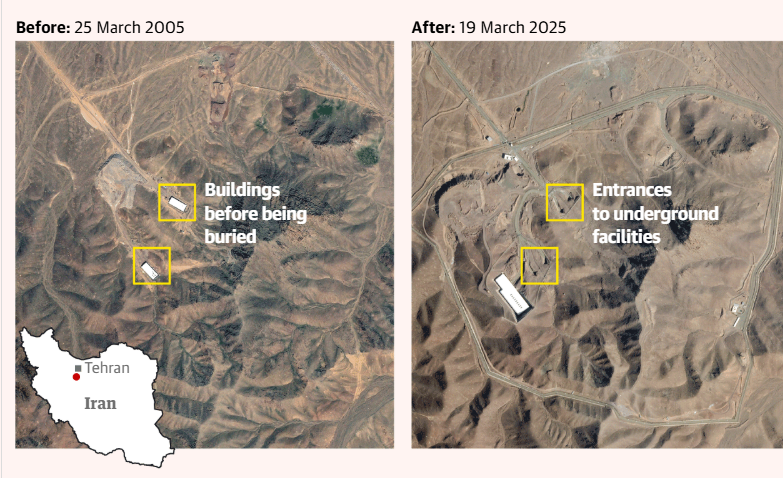
Meanwhile, the presence of critical U.S. military assets near Iran sends a strong signal. The Pentagon appears ready for any scenario, keeping all options on the table without committing to one. The question remains: is this just strategic posturing, or the calm before a high-stakes strike?
Courtesy of The Guardian
For article publication inquiries, feel free to get in touch