

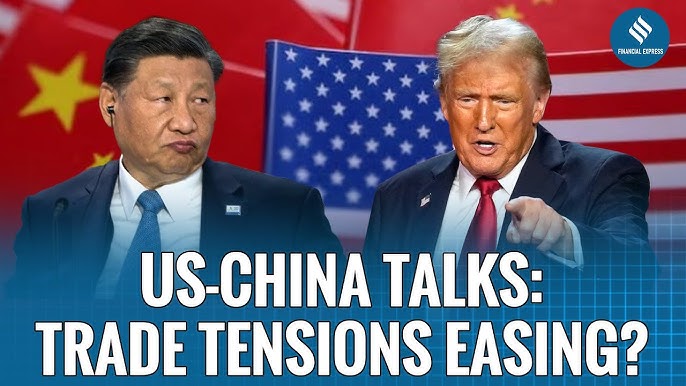
The Trade war between the United States and China is now on hold. On Monday, both countries agreed to stop most of the high tariffs they had placed on each other. This temporary truce will last for 90 days. The decision came after two days of talks in Geneva.
This move aims to reduce global economic tensions. It also brings a break in a conflict that had shaken financial markets.
What Changes With the Tariff Freeze?
Furthermore, both countries will roll back some of their recent tariffs. Specifically, the U.S. will lower its tariffs on Chinese goods from 145% to 30%, while China will reduce its tariffs on U.S. products from 125% to 10%. According to the joint statement, these cuts will take effect by May 14.
As a result, the reductions offer a chance for fresh talks. Speaking after the Geneva meeting, U.S. Trade Representative Jamieson Greer said the goal is to reach a fairer deal.
Stock Markets and Currencies React
Markets responded quickly. In Hong Kong, the stock exchange jumped over 3%. The U.S. dollar, which had been falling, gained strength against the yen and euro.
Investors welcomed the news. The trade war had added major risks to global trade. Now, this break brings hope for more stability.
A Desire to Avoid Economic Separation
U.S. Treasury Secretary Scott Bessent emphasized that both nations want to stay connected. “No one wants to split the two economies,” he explained. Instead, “we want fair trade, not separation.”
Moreover, Bessent said that the recent high tariffs were almost like an embargo. They effectively blocked normal trade and hurt businesses and consumers on both sides.
Meanwhile, China’s Ministry of Commerce also welcomed the deal. They called the talks a “step forward” and noted that the world benefits from this pause.
Geneva Talks: Face-to-Face for the First Time
This meeting was the first face-to-face discussion since the U.S. imposed steep tariffs in April. In response, China hit U.S. goods with its own high tariffs. The back-and-forth raised fears of a lasting economic fight.
The U.S. sent Greer and Bessent to the talks. China was represented by Vice Premier He Lifeng. After two days, both sides reported progress.
He Lifeng said the discussions were “frank, deep, and helpful.” He added that both countries had made “real progress.”
A Framework for Future Talks
The U.S. and China also agreed to create a system for ongoing discussions. The aim is to avoid further trade shocks and to build a long-term plan.
While the White House called it a new “trade agreement,” details remain unclear. Still, officials on both sides sounded hopeful.
The Global Impact of the Trade War
The Trade war had global effects. Prices rose in the U.S., and China’s economy slowed. Many feared it would spark a wider downturn.
Ngozi Okonjo-Iweala, head of the World Trade Organization, praised the truce. She said it would help not just the U.S. and China but also poorer nations. “This is a good start,” she said after meeting He Lifeng in Geneva.
She added that less tension between these two powers benefits the whole world.
A Quiet Setting for Important Talks
The talks took place in a private villa in Geneva. The location was the home of the Swiss ambassador to the U.N. The calm setting helped both sides focus on the issues.
Just before the talks, President Trump had signed a trade deal with the United Kingdom. That agreement also aimed to lower tariffs and encourage trade.
Not the End, But a New Chapter
The 90-day pause is a step in the right direction. But experts warn that it is only a start. The root causes of the Trade war remain.
Both countries need to keep talking. Moreover, they must also take action to solve deeper problems, like unfair trade practices and market access.
Still, this truce offers hope. If both sides continue to work together, a stronger and fairer deal might follow.
Looking Ahead
The U.S. and China now have a chance to reset. This 90-day break allows for honest talks. It also eases fears in the global economy.
A lasting solution will take time. But for now, the world can breathe a little easier. The Trade war may not be over, but it is on pause—and that matters.
Courtesy of Defimedia
For article publication inquiries, feel free to get in touch.