


An AI-powered robot can now make coffee while learning and adjusting on the spot. This innovative machine, developed at the University of Edinburgh, does more than follow commands. It reacts to its surroundings, makes decisions, and solves problems in real time—just like a person in a busy kitchen.
As a result, the gap between mechanical automation and human-like intelligence is shrinking. By combining flexible movement and AI, researchers have created a robot that not only works—but thinks.
Smarter Machines Enter the Kitchen
While robots perform well in factories, they often fail in messy or fast-changing places like kitchens. These real-world spaces come with surprises, noise, and constant change.
Traditional robots are limited because they depend on strict programming. When things shift or go wrong, they stop. In contrast, this new robot adapts as needed. Thanks to AI, it processes real-time data and responds intelligently.
Moreover, it interprets commands, studies its surroundings, and learns how to act—without being told exactly what to do.
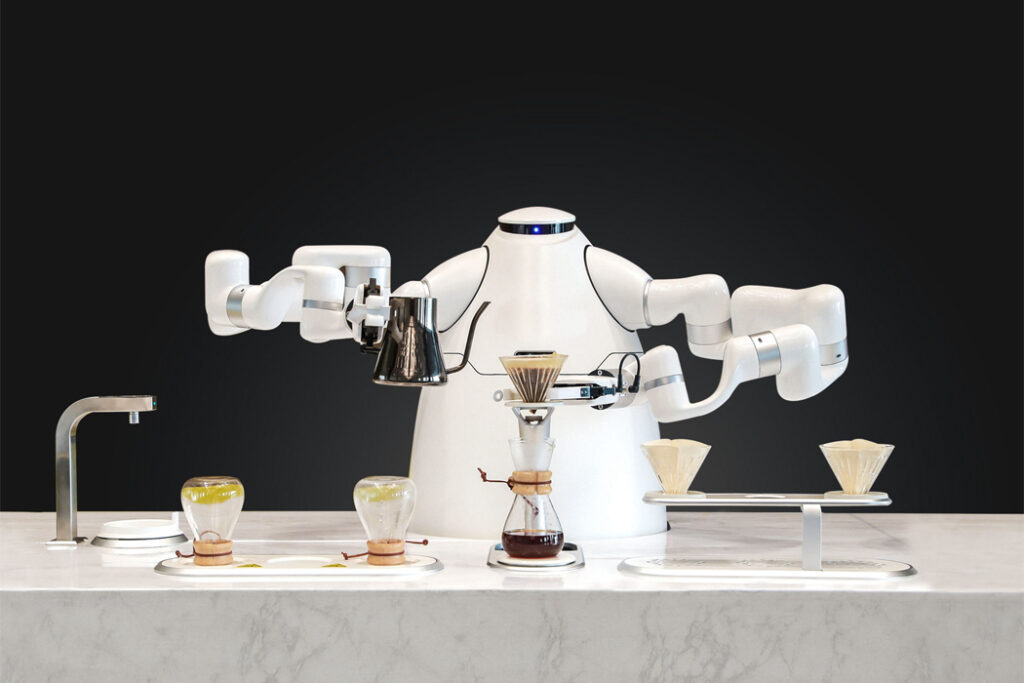
How the AI Robot Works
The robot features a flexible arm with seven movable joints. These joints allow it to perform delicate movements, such as grabbing a mug or opening a drawer. More importantly, it uses a powerful AI system that combines speech recognition, vision, and motion planning.
Here’s what it does step by step:
- First, it listens to a command like “make coffee.”
- Then, it scans the room to find items like mugs, kettles, and jars.
- Next, it figures out how to open drawers—even ones it’s never seen before.
- Finally, it brews the coffee by mixing water and grounds in the right amounts.
If something goes wrong—for example, someone moves the mug—it quickly adjusts. Rather than stopping, it finds the new location and continues.
Beyond the Factory Floor
What makes this robot stand out is its blend of movement and intelligence. In the past, robotics and AI developed along separate paths. Engineers built smart software, while others focused on hardware. However, this robot shows the value of combining both.
In doing so, the research team created a machine that fits better into daily life. It doesn’t need perfect conditions to work. It thinks through problems as they happen.
This approach opens the door to new possibilities. Robots like this one could soon help in kitchens, hospitals, or even disaster zones.
Why Adaptability Is Key
In real life, things rarely stay the same. Humans constantly adapt. We change our plans, solve problems, and adjust to whatever comes our way.
For example, imagine reaching for a coffee mug and discovering it’s gone. You’d look around and try again. Until recently, robots couldn’t do that. But this AI robot can. It detects changes and updates its plan.
Therefore, robots that adapt are far more useful than those that just repeat steps. They can work safely around people, respond to errors, and finish tasks—even in chaos.
The Research Behind the Robot
The full study appeared in Nature Machine Intelligence on March 19, 2025. It was led by Ruaridh Mon-Williams, a PhD student affiliated with the University of Edinburgh, MIT, and Princeton.
The team included experts in robotics, machine learning, and human behavior. Their project received support from the UK’s Engineering and Physical Sciences Research Council (EPSRC).
Mon-Williams explained that human intelligence is a blend of reasoning, perception, and action. Until now, AI systems have usually focused on just one of those areas. This project brings them together.
A Glimpse Into the Future
This coffee-making robot isn’t just a fun science experiment. It’s a sign of what’s coming next. As AI improves, robots will become more helpful in real-world spaces.
Imagine home assistants that can cook, clean, or care for loved ones. These tasks are hard to automate because they depend on flexibility. Fortunately, robots like this one show that smart systems can now handle those demands.
In addition, this type of technology has value in fields like elder care, emergency response, and customer service. As machines become more responsive, they will support human needs in better and safer ways.
Ethics and Human Impact
Of course, not all changes come without questions. Smarter machines bring challenges, too. How do we keep them safe? Who controls their decisions? What happens to jobs?
These are critical issues that researchers must face. The Edinburgh team stresses that their goal is to build AI that supports—not replaces—humans.
Therefore, public discussion around safety, fairness, and trust in intelligent machines will be essential. Design choices should reflect shared values, especially as machines enter homes and public life.
Final Thoughts
This new robot blends AI, movement, and real-time problem-solving to brew a simple cup of coffee. But the technology behind it is far from simple.
It listens, learns, adapts, and finishes tasks without needing detailed instructions. In short, it thinks on its feet—just like we do.
That’s the future of robotics. It’s not just about automation. It’s about interaction, learning, and tools that work with us—not just for us.
Courtesy of SciTechDaily
For article publication inquiries, feel free to get in touch.